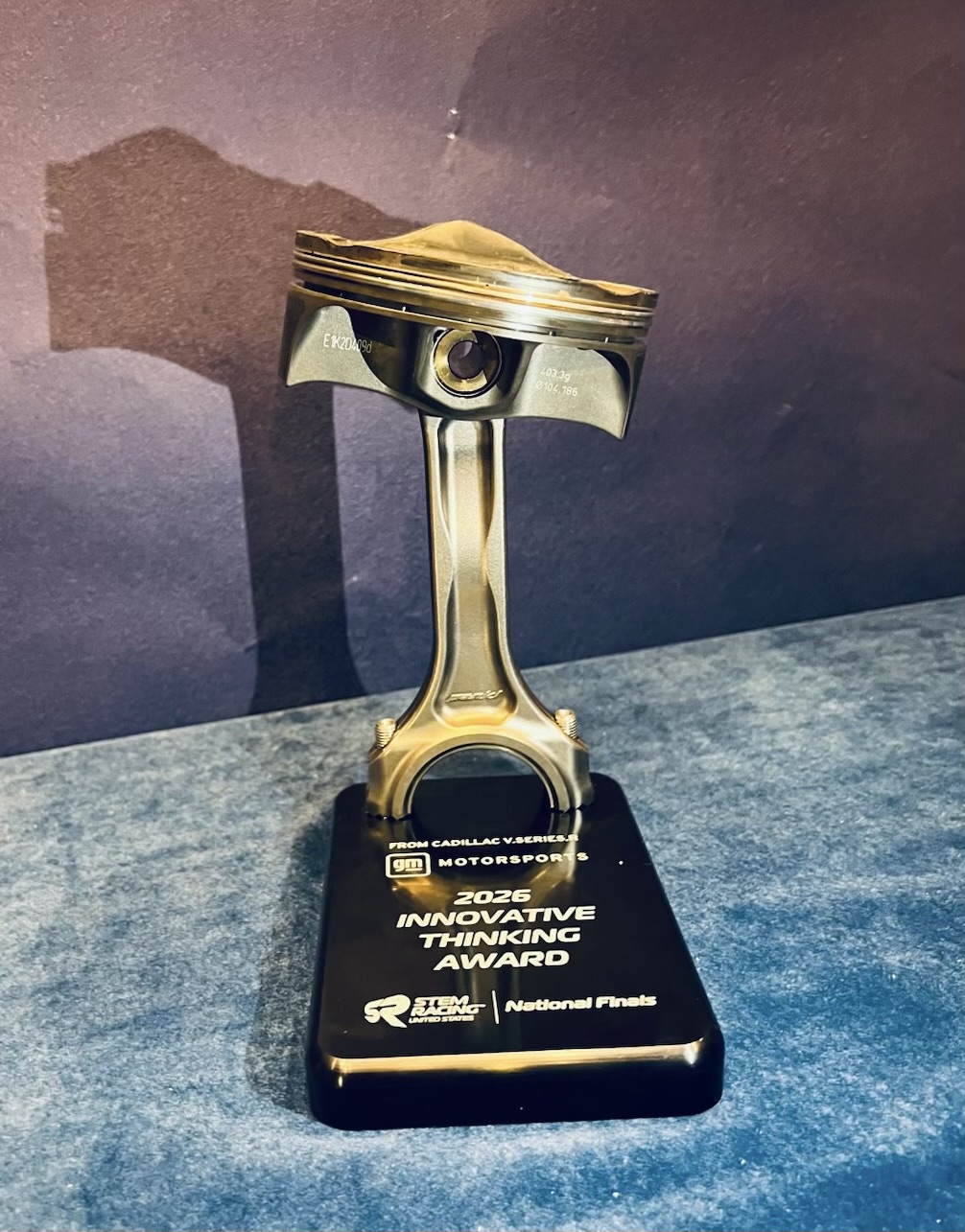
GM Motorsports Innovative Thinking Award, 2026 STEM Racing National Finals.
The 2026 program
The car was the starting point. The engineering program grew around it.
Griffin Racing’s 2026 car program finished third at the Regional competition and received the GM Motorsports Innovative Thinking Award at the National Finals. The award shown here recognizes the development program that grew around the vehicle, not a styling exercise or a single isolated feature.
The team built its workflow around specific engineering questions raised by the car. PyMesh prepares the computational domain and concentrates resolution around the vehicle. PyCFD evaluates aerodynamic behavior, with the team’s two-dimensional implementation reaching approximately ±5% agreement with ANSYS in the relevant validation work. PyFEA is used to inspect structural response before a part is committed to manufacture. PyTrack then places vehicle behavior back into the timing and sequence of a competition run.
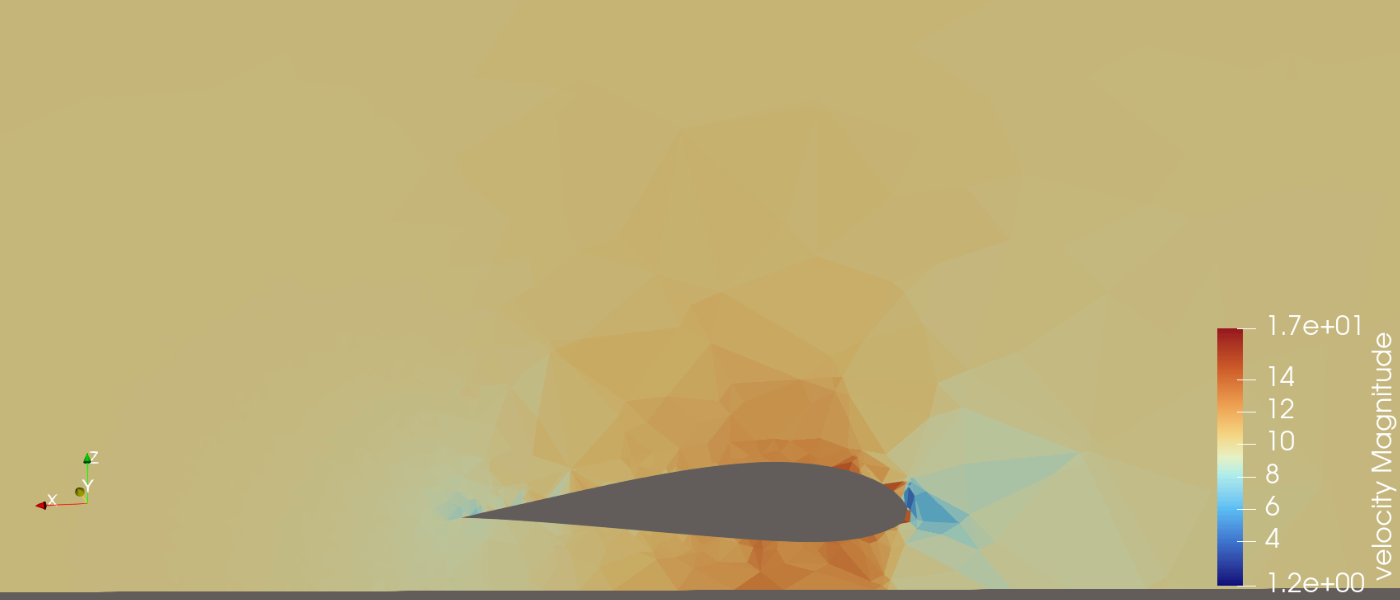
The car’s geometry is evaluated inside a locally refined computational domain. Velocity-magnitude results are compared with external reference results rather than accepted on appearance alone. The verified claim is limited to the relevant two-dimensional validation work, where agreement reached approximately ±5%.
Structure before manufacture
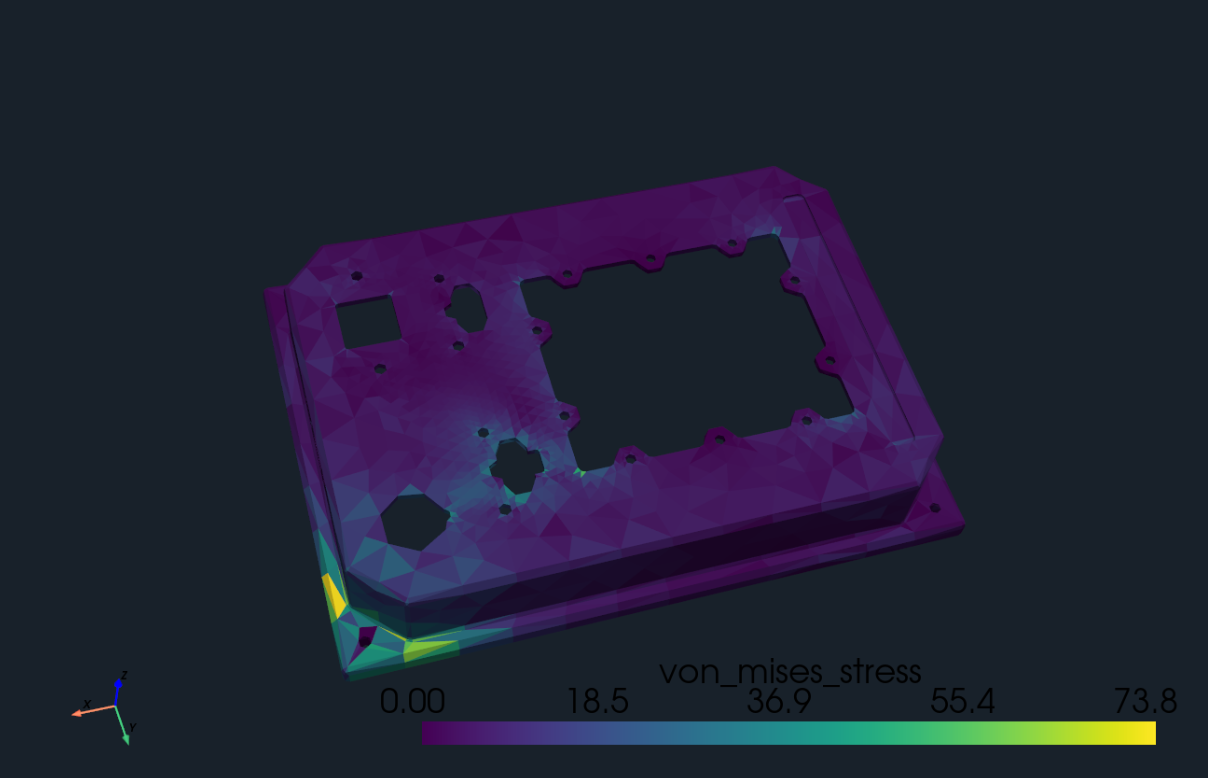
PyFEA provides stress and displacement fields for components before fabrication. Those results remain inspectable in PyVisual, including the underlying point and cell arrays, scalar ranges, pipeline operations, and filtered datasets used to interpret the solution.
One program, not one model
The car created the need for geometry tools, meshing, CFD, FEA, visualization, race simulation, manufacturing decisions, and physical validation. Those needs became PyCAE and extended into materials work, including HPAB films and the team’s own Griffin Blue pigment.
Engineering
A connected development method.
Griffin Racing approaches STEM Racing as an engineering program. Decisions move from constrained geometry to computational prediction, manufacturing, physical measurement, comparison, and a more informed return to design.
Design
Vehicle geometry begins with competition constraints, component packaging, aerodynamic intent, structural requirements, manufacturing limitations, and mass considerations. A design must work as a complete system rather than optimize one discipline in isolation.
Manufacture
Digital geometry has to survive contact with a real process. Fabrication planning, tolerances, assembly, and material behavior determine whether an idea can become a repeatable physical component. Production feedback often exposes the next design question.
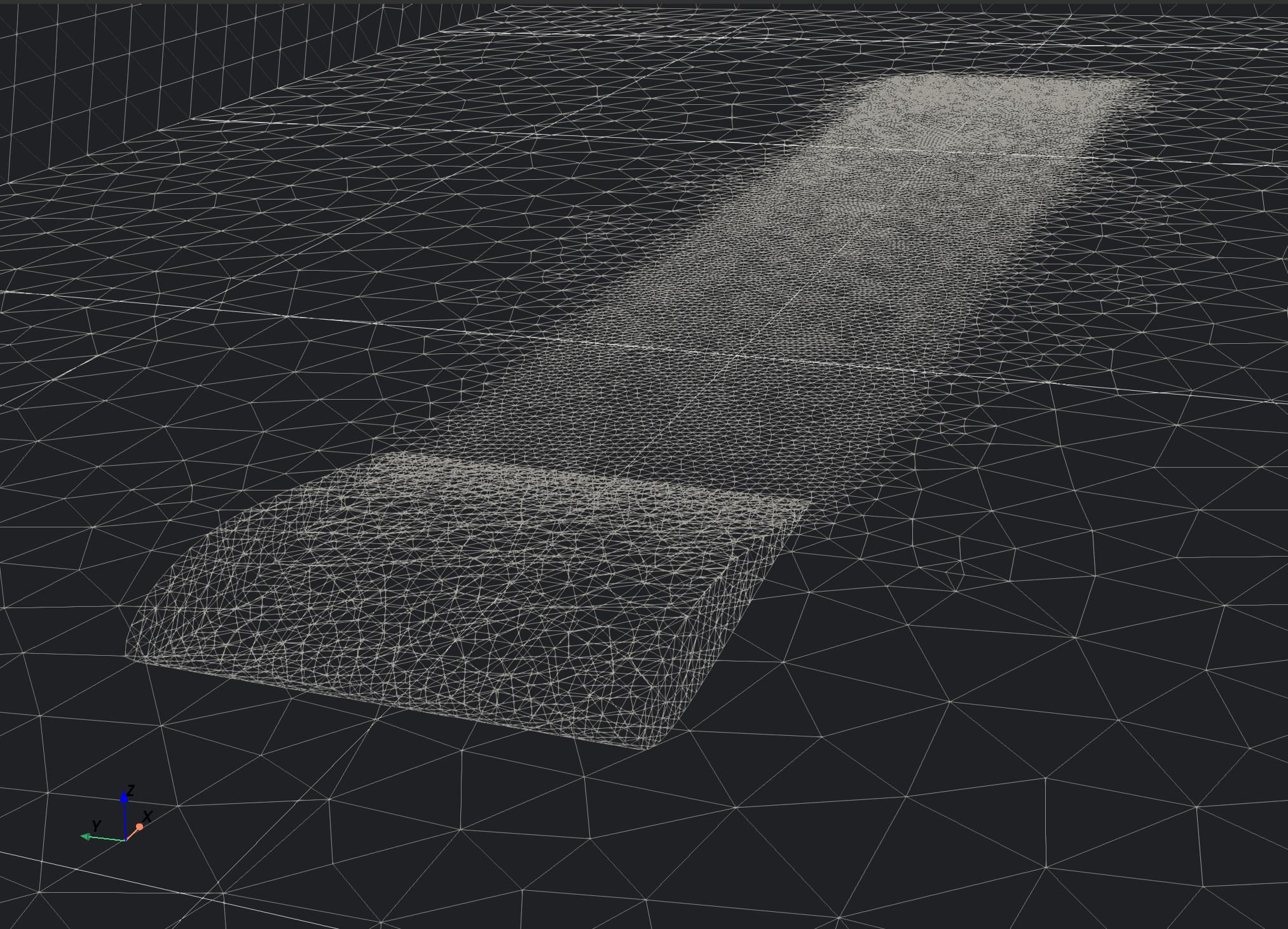
Computational domain with local refinement around the vehicle geometry.
Simulation begins with a usable domain.
Before a numerical solver can evaluate aerodynamic behavior, the geometry and surrounding computational domain must be discretized. Local refinement concentrates smaller elements around the car and its wake, where changes in the solution require greater spatial resolution.
Meshing is therefore an engineering decision, not a decorative preprocessing step: element distribution affects what the solver can resolve, how much computation is required, and how confidently the result can inform the next design.
Prediction, then evidence.
PyCFD is used to investigate aerodynamic behavior before committing to physical iterations. The supplied result visualizes velocity magnitude around a two-dimensional car profile, making changes in the surrounding flow field available for comparison.
Computational results are not accepted blindly. Griffin Racing compares predictions with physical measurements and external reference tools where appropriate.
PyCFD velocity-magnitude output from Griffin Racing development work.
Test
Physical testing establishes how the manufactured system behaves outside the model. Measurement provides evidence about the real car rather than simply confirming an assumption.
Validate
Predictions, measured behavior, and reference tools are compared to understand agreement, discrepancy, and the limits of the current model.
Iterate
Discrepancies and observed behavior return to the next geometry, allowing the team to make subsequent decisions with more information than the previous cycle.
PyCAE
Control the engineering workflow.
PyCAE is Griffin Racing’s internally developed computer-aided engineering ecosystem. It was created to give the team greater understanding and control over its computational workflow rather than treating simulation as a black box.
Analysis results that remain inspectable.
PyVisual is the interpretation layer within PyCAE. It presents computational results in three dimensions so geometry, scalar fields, and the spatial distribution of a solution can be examined together.
This interactive result is rendered from the supplied PyAnalysis VTU solution. It preserves the original surface topology, point displacement magnitudes, Viridis color mapping, scalar range, and native PyVisual camera orientation. Rotate, pan, and zoom to inspect the result directly.
Loading PyVisual session
Interactive PyVisual displacement result loaded from the supplied solution.
Input
Geometry and engineering data enter the analysis environment.
Discretize
PyMesh prepares geometry and computational domains for numerical analysis.
Solve
PyCFD and PyFEA evaluate aerodynamic and structural behavior.
Interpret
PyVisual supports result inspection, comparison, and scientific visualization.
Apply
PyTrack and related tools connect computation to vehicle development and competition.
PyCAD
Geometry and CAD tools supporting the creation and manipulation of engineering geometry.
PyMesh
Mesh-generation infrastructure used to prepare geometry and computational domains for numerical analysis.
PyCFD
Computational fluid dynamics tools used to investigate aerodynamic behavior and compare predicted flow response.
PyFEA
Finite element analysis tools used to study structural response and support decisions about components and loading.
PyVisual
Scientific visualization for interpreting, presenting, and comparing computational results.
PyTrack
Race and track simulation connecting engineering work with vehicle behavior in the context of competition.
PyFEA von Mises stress output, including the complete result legend.
Structural response with PyFEA
The supplied result shows a von Mises stress field on an analyzed component. FEA helps the team examine how a structure responds to loading before manufacturing, identify where response is concentrated, and compare design alternatives with a consistent numerical method.
The visualization is an interpretation layer over the underlying analysis. It does not replace understanding assumptions, boundary conditions, and physical validation.
Race context with PyTrack
PyTrack extends the software effort beyond isolated component or flow analysis. It places vehicle behavior into the sequence and timing of a competition run, connecting computational development with the environment in which the car is evaluated.
This supplied demonstration plays once in place. It stops at the final frame and only runs again when the visitor chooses Replay.
The HPAB project studies agarose-based films modified with polyethylene glycol, a calcium chloride–urea deep eutectic solvent, and hybrid PEG-DES plasticization. The objective is to understand how different plasticization systems change material behavior, not simply to produce a material that appears sustainable.
Why compare plasticization systems?
Agarose films can exhibit useful material behavior, but formulation determines whether a film is stiff, flexible, strong, deformable, or thermally stable. Comparing PEG, DES, and hybrid PEG–DES systems lets the research examine the tradeoffs created by each approach and whether a combined formulation produces a more balanced response.
What was characterized?
The study followed material formulation and casting with thermal testing and mechanical characterization. Tensile and puncture pathways were used to examine mechanical behavior, while four transition temperatures were recorded during thermal testing.
PEG
Polyethylene glycol plasticization produced a stiffer film with increased strength and thermal stability in the supplied research.
DES
Deep eutectic solvent plasticization increased flexibility and deformability while reducing strength.
Hybrid PEG–DES
The combined system balanced behaviors from the individual plasticizers and produced the highest mean temperature across all four measured thermal transitions.
Thermal transition means
Thirty-six films were measured, with 12 in each formulation. Across onset, deformation, peak melting, and final melting temperatures, the hybrid formulation recorded the highest mean value.
The chart reports the measured formulation means. The inferential analysis and experimental sample structure are summarized immediately below.
Thermal behavior differed significantly among formulations.
|d| 6.13–39.04pairwise effect sizes
The supplied analysis reported extremely large thermal contrasts.
12 attemptsunplasticized controls
Pure agarose controls failed during handling before mechanical testing.
Hybrid response beyond the linear-additive prediction.
These values report observed hybrid temperature minus the linear-additive prediction for a 1:1 PEG/DES combination. Positive deviations appear at all four transitions. This comparison describes the measured thermal response and does not, by itself, establish a molecular mechanism.
OST+9.08°C
DEF+26.44°C
PMT+17.81°C
FMT+15.92°C
Observed hybrid minus linear-additive prediction, in degrees Celsius.
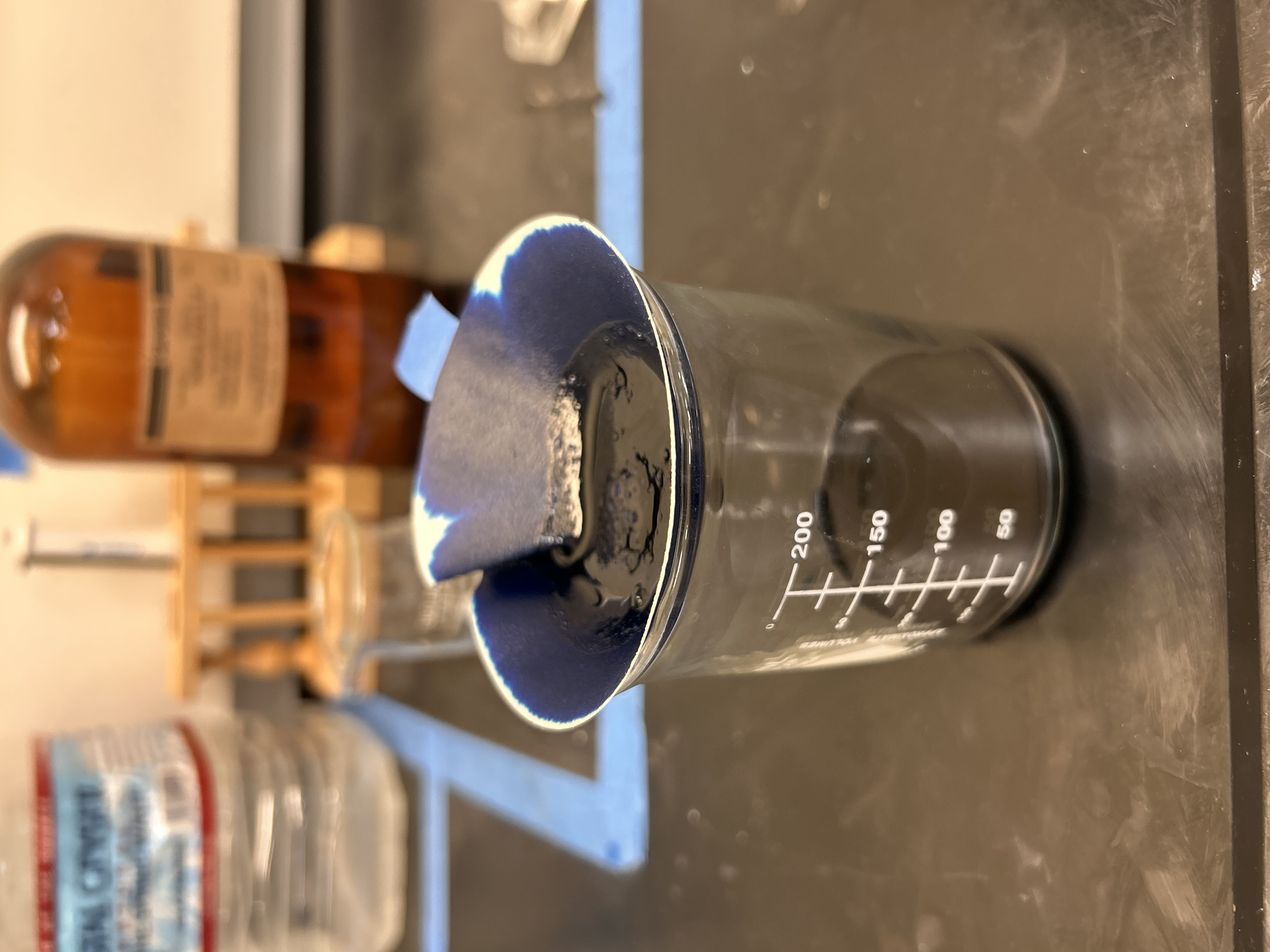
Preparation of Griffin Blue, Griffin Racing’s modified Methylene Blue Lake Pigment.
Applied materials work
Griffin Blue pigment.
Griffin Blue is a modified Methylene Blue Lake Pigment developed by Griffin Racing for the team’s custom eco-friendly paint. The photograph documents the pigment-making process in the laboratory, with the blue material collected on the filter medium above the preparation vessel.
This work brings materials development directly onto the car. The team is not selecting an off-the-shelf blue and describing it as research. It is developing the pigment used to establish the vehicle’s Griffin Blue finish and integrating that material into a custom paint system.
From experiment to scientific communication.
The work progressed from formulation and casting through measurement, comparison, engineering interpretation, and preparation for external scientific review. This sequence keeps the research grounded in reproducible experimental work while extending it into formal communication.
The car, software, research, operations, communications, and visual identity only move forward when specialized responsibilities stay connected.
Ethan Cohen
Team Principal & Design Engineer
Ethan sets the technical direction of the car and integrates work across vehicle design, simulation, manufacturing, testing, and iteration. The role connects engineering decisions across disciplines while keeping development priorities focused on the competition program.
Scarlet Martinez
Manufacturing Engineer
Scarlet translates digital designs into physical components. Her role considers manufacturability, fabrication processes, tolerances, assembly, and the production feedback that helps the team refine subsequent geometry.
Ryan Ruan
Social Media & Marketing Manager
Ryan communicates the team’s work publicly, documents development, manages outward-facing content, and supports sponsor visibility. The role helps make complex technical progress understandable without losing the substance of the engineering.
Emily Chen
Team Manager
Emily coordinates schedules, logistics, deadlines, deliverables, and competition preparation. Her operational work keeps the team’s engineering, manufacturing, communications, and presentation efforts moving together.
Winnie Pan
Graphic Designer
Winnie maintains Griffin Racing’s visual identity across competition materials, presentations, communications, and supporting visual assets. The role ensures that the team’s technical work is presented clearly and consistently.
Partners
Support behind the work.
Every organization represented in Griffin Racing’s supplied sponsor archive.
Build with Griffin Racing.
We welcome conversations around sponsorship, technical collaboration, research, manufacturing, and engineering support.